
 admin
admin
Welcome to the exciting world of math playzone, where numbers, logic, and interactive fun collide to create an unforgettable learning experience. In today’s digital era, traditional teaching methods often struggle to capture the short attention spans of young learners. Children thrive in environments that combine entertainment with education, making concepts feel like games rather than chores. By incorporating vibrant visuals, dynamic challenges, and progressive difficulty levels, modern educational platforms successfully turn intimidating equations into thrilling adventures. Whether you are an educator looking to inspire your students or a parent eager to support your child’s academic journey at home, embracing this playful approach unlocks new levels of cognitive growth, curiosity, and lifelong academic confidence.
Quick Bio
| Attribute | Details |
|---|---|
| Topic | Math Playzone |
| Core Focus | Gamified Mathematics and Interactive Learning |
| Target Audience | Students, Parents, and Educators |
| Primary Benefit | Enhancing Numerical Fluency Through Play |
Understanding the Core Philosophy of Interactive Education
At the heart of every successful math playzone lies the fundamental belief that children learn best when they are actively engaged and genuinely enjoying themselves. Traditional rote memorization often leads to math anxiety, creating mental blocks that hinder long-term progress. In contrast, interactive learning environments encourage experimentation, trial, and error without the fear of failure. When learners realize they can test different strategies, solve puzzles, and earn virtual rewards, their intrinsic motivation skyrockets. This positive reinforcement transforms the classroom or living room into a laboratory of discovery, where every mistake is viewed simply as a stepping stone toward mastering a challenging concept.
The Evolution of Traditional Mathematics Into Modern Gamified Learning
Mathematics has come a long way from chalkboards and heavy textbooks filled with endless drills. The integration of gamified mechanics into educational spaces represents a massive paradigm shift in how we approach STEM education. A well-designed math playzone takes core curriculum standards and wraps them in engaging narratives, quests, and visual rewards. Learners do not just solve arithmetic problems; they build virtual empires, navigate tricky mazes, and defeat numerical dragons using fractions and geometry. This seamless blend of storytelling and serious academic content ensures that learners stay focused for longer periods, absorbing complex mathematical principles effortlessly while having absolute fun.
Boosting Cognitive Development Through Interactive Numerical Challenges
Engaging with interactive digital puzzles stimulates multiple areas of the brain simultaneously, fostering critical thinking and strategic planning skills. Within a dynamic math playzone, users are constantly required to analyze patterns, calculate probabilities, and deduce missing variables under time-bound challenges. These mental exercises sharpen working memory and enhance spatial reasoning capabilities far beyond what traditional paper worksheets can achieve. As learners repeatedly tackle these adaptive challenges, their brains build stronger neural pathways for logical processing, which ultimately translates to improved performance across all academic subjects that require analytical rigor.
Creating an Inclusive Environment for Learners of All Skill Levels
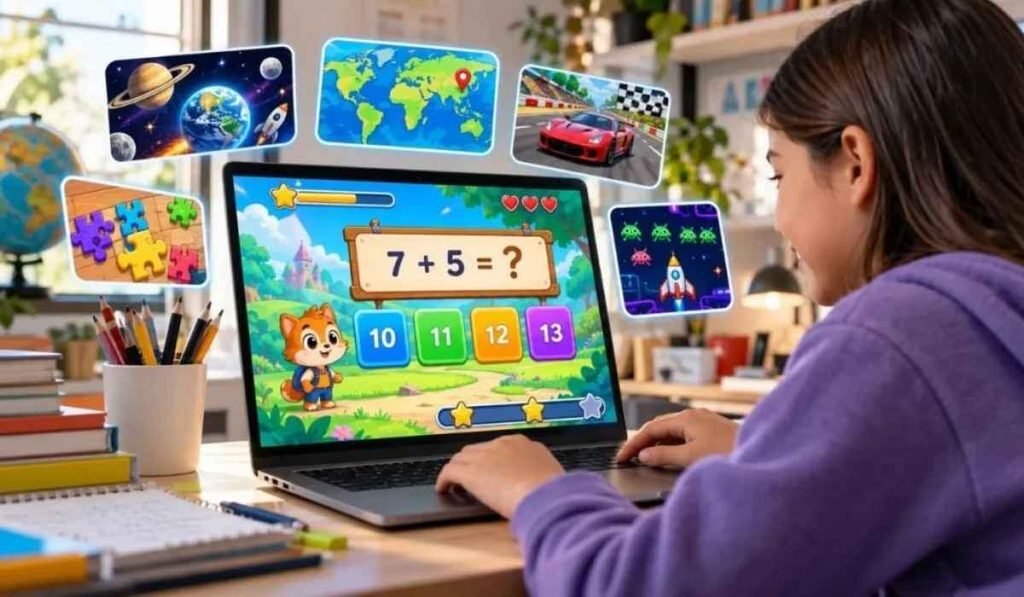
One of the greatest advantages of modern digital learning spaces is their ability to adapt to individual pacing and skill levels. A comprehensive math playzone features customizable difficulty settings, ensuring that struggling students receive gentle scaffolding while advanced learners encounter stimulating enrichment problems. This personalized approach eliminates the frustration of moving too fast or the boredom of lagging behind the rest of a group. By celebrating small victories and providing immediate, constructive feedback, these platforms build unshakeable self-esteem and foster a growth mindset in every single participant.
Seamlessly Integrating Technology Into Daily Educational Routines
Integrating educational games into a daily routine does not require massive investments of time or specialized hardware. Incorporating just fifteen minutes of math playzone activities into a morning or afternoon schedule can yield remarkable long-term improvements in numerical fluency. Parents and teachers can easily sync these interactive sessions with ongoing classroom topics to reinforce current lessons. This consistency bridges the gap between formal school instruction and informal play, demonstrating to learners that mathematics is not confined to the classroom but is an active, vibrant tool relevant to everyday life.
Fostering Social Collaboration and Healthy Peer Competition
Learning does not always have to be a solitary endeavor; multiplayer features within digital educational platforms bring a vibrant social dimension to studies. In a collaborative math playzone, peers can team up to solve multi-stage mathematical mysteries or participate in friendly, low-stakes competitions to see who can solve quick arithmetic puzzles fastest. This teamwork encourages communication, peer-to-peer explanation of concepts, and shared problem-solving strategies. When students articulate how they arrived at a specific answer to their friends, their own comprehension deepens significantly through active verbalization and shared encouragement.
Bridging the Gap Between Abstract Concepts and Real-World Applications
One of the most common complaints from students is that mathematics feels entirely abstract and detached from daily reality. A well-constructed math playzone actively counters this perception by anchoring digital puzzles in real-world scenarios, such as managing a virtual grocery store, budgeting for a construction project, or calculating travel speeds. By connecting mathematical symbols and formulas to tangible outcomes, learners grasp the practical utility of what they are studying. This vital context transforms math from a dreaded school subject into an indispensable superpower for navigating the modern world successfully.
Empowering Educators With Advanced Progress Tracking Tools
Teachers face the monumental task of addressing diverse learning needs within a single classroom setting. Fortunately, modern educational hubs within a math playzone come equipped with robust analytics dashboards that monitor individual student progress in real time. Educators can instantly identify which specific concepts—such as long division, algebraic balancing, or fraction reduction—are causing widespread confusion. Armed with this precise data, teachers can tailor their direct instruction, assign targeted practice modules, and ensure that no student falls through the cracks of the standard curriculum.
Cultivating Resilience and Overcoming Math Anxiety
Math anxiety is a genuine psychological barrier that affects millions of learners worldwide, often causing them to freeze up during assessments. A structured math playzone helps dismantle this anxiety by framing challenges as low-stakes games where failure carries zero penalties. When learners experience repeated, low-pressure attempts at solving difficult puzzles, their emotional reactivity to math diminishes. They begin to view challenges as exciting puzzles to unravel rather than terrifying obstacles, building the emotional resilience necessary to tackle advanced STEM topics later in life.
Empowering Parents to Take an Active Role in Home Education
Parents often feel unequipped to help their children with advanced schoolwork, especially as curricula evolve and modern teaching methods change. A user-friendly math playzone acts as a bridge, allowing parents to participate in their child’s learning journey without needing an advanced degree in mathematics. Shared gaming sessions enable families to bond over fun puzzles, transforming homework time into quality family time. Parents can witness firsthand where their child excels and where they might need a little extra encouragement, creating a supportive united front between home and school.
Designing Accessible Learning Spaces for Diverse Learners
Accessibility is a crucial pillar of modern educational technology, ensuring that no learner is left behind due to physical or cognitive differences. A forward-thinking math playzone incorporates customizable visual themes, adjustable font sizes, screen-reader compatibility, and intuitive touch or keyboard controls. These thoughtful accommodations ensure that students with visual impairments, motor skill challenges, or neurodivergent profiles can navigate the platform comfortably. By prioritizing universal design, digital learning spaces become truly democratic environments where every child has an equal opportunity to thrive.
Leveraging Gamification to Drive Sustained Academic Engagement
Gamification is far more than just adding flashy graphics and sound effects to boring lessons; it is a scientifically proven method for sustaining attention and driving motivation. Elements like achievement badges, streak counters, and unlockable avatars within a math playzone tap into the human brain’s natural desire for mastery and progression. When learners see their hard work visualized through milestone celebrations, their drive to complete tasks and explore advanced topics surges. This positive feedback loop replaces external pressure with genuine internal enthusiasm for continuous learning and self-improvement.
Strengthening Foundational Arithmetic for Long-Term Academic Success
Advanced mathematical concepts like calculus and trigonometry cannot be mastered without a rock-solid foundation in basic arithmetic and algebraic manipulation. Regular sessions within a dedicated math playzone ensure that core skills—such as multiplication tables, mental math shortcuts, and fraction equivalents—become entirely second nature. When these foundational operations require zero conscious effort, cognitive bandwidth is freed up to tackle higher-level problem-solving and abstract theoretical thinking, paving the way for future success in competitive academic and professional environments.
Cultivating Critical Thinking Beyond the Standard School Curriculum
Standardized tests often prioritize rote repetition and formulaic memorization over genuine critical thinking and creative problem-solving. An immersive math playzone breaks free from these rigid testing constraints by introducing open-ended logic puzzles, spatial riddles, and multi-step strategy challenges. Learners are encouraged to think outside the box, test unconventional hypotheses, and discover multiple valid pathways to a single solution. This flexibility nurtures innovators, engineers, and creative thinkers who can approach complex, real-world problems with confidence and original insight.
Transitioning From Passive Screen Time to Active Cognitive Engagement
In the modern digital age, concerns surrounding excessive screen time are entirely valid for parents and educators alike. However, not all screen time is created equal, and the distinction between passive consumption and active participation is vital. Engaging with a math playzone shifts children away from passive video viewing and into an active cognitive state where they must make decisions, calculate outcomes, and solve complex problems. This intentional use of technology transforms digital devices into powerful mental gymnasiums that stimulate active learning rather than mental stagnation.
Encouraging Independent Exploration and Self-Directed Learning
Self-directed learning is an invaluable skill that serves individuals well into adulthood, fostering independence and lifelong curiosity. Within a well-structured math playzone, learners are given the autonomy to choose which topics to explore, which challenges to tackle next, and how quickly they wish to progress. This freedom encourages children to take ownership of their education, pursuing topics that spark their personal interest rather than merely following a rigid teacher-led syllabus. As a result, they develop robust self-regulation skills and a genuine love for independent discovery.
Enhancing Memorization Through Dynamic Multisensory Feedback
Human memory is significantly enhanced when information is processed through multiple sensory channels simultaneously, combining visual, auditory, and kinesthetic feedback. A dynamic math playzone utilizes bright color coding, engaging sound effects, and interactive touch responses to reinforce correct answers and clarify mistakes instantly. When a learner hears a cheerful chime, sees a vibrant animation, and physically drags a virtual number into place, their brain forms richer, more durable memory traces of the underlying mathematical principle being practiced during the session.
The Vital Role of Continuous Practice in Long-Term Retention
The psychological phenomenon known as the forgetting curve proves that newly acquired knowledge fades rapidly unless it is systematically reinforced over time. Regular visits to a dedicated math playzone utilize spaced repetition algorithms to reintroduce challenging concepts just as the brain is about to forget them. This scientifically backed approach ensures that numerical facts and problem-solving techniques transition smoothly from short-term working memory into permanent long-term storage, guaranteeing that academic gains are retained long after the school year ends.
Looking Forward: The Bright Future of Gamified STEM Education
As emerging technologies like artificial intelligence, augmented reality, and adaptive learning algorithms continue to evolve, the landscape of digital education is expanding exponentially. Future iterations of the math playzone will offer even more immersive, hyper-personalized experiences that adapt seamlessly to each learner’s unique emotional and cognitive state. By continuing to bridge the gap between rigorous academic standards and playful, engaging exploration, we are equipping the next generation with the analytical tools, confidence, and resilience needed to shape a brilliant, mathematically literate future. For further insights into the history and evolution of educational technology, you can explore the Education.
Frequently Asked Questions
- What is a math playzone? A digital or physical environment that combines interactive games with mathematics to make learning engaging and fun.
- Who can benefit from using a math playzone? Students of all ages, parents, and educators looking to improve numerical fluency and reduce math anxiety.
- How does gamification improve math skills? It turns repetitive drills into rewarding challenges, boosting motivation, retention, and critical thinking.
- Can a math playzone replace traditional classroom teaching? No, it serves as a powerful supplementary tool to reinforce classroom lessons and encourage self-paced practice.
- Are these platforms suitable for beginners? Yes, most platforms feature adjustable difficulty levels that cater to complete beginners and advanced learners alike.